

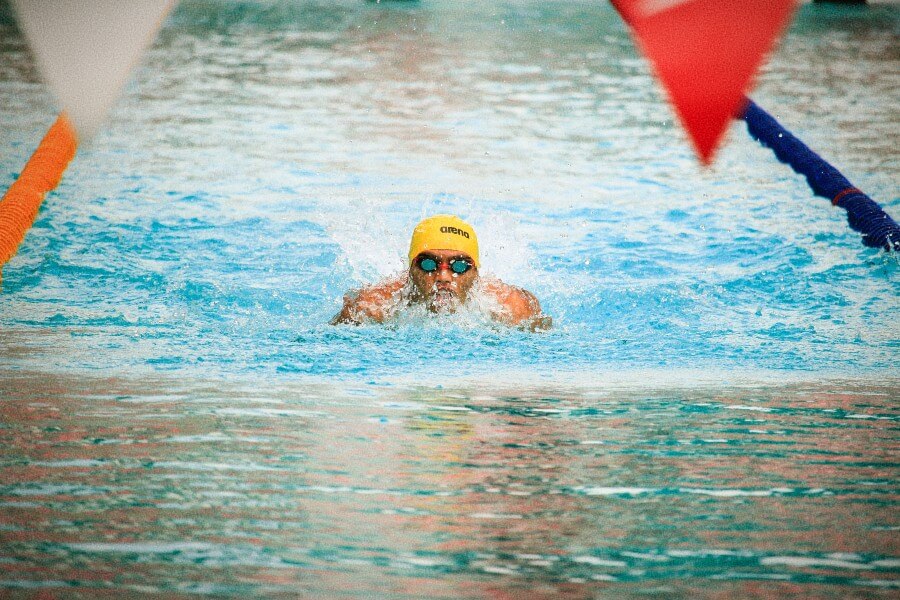
Swimming is a very good sport for your heart which allows you to improve your endurance and your breath throughout the sessions!
When you swim, prolonged efforts that you provide solicit your muscles and help you to improve your cardiovascular capacity And pulmonary.
Swimming for the well-being of your cardio
Swimming helps you improve your endurance
The more you swim often And a long time In your workouts swimming, the more you go increase your muscular endurance capabilities. To swim long term, you must be able to measure your effort.
To improve your endurance, you must also adopt a good swimming technique during your swimming exercises. The better she will be, the less energy you will waste and the longer you will last.
Swimming also and above all allows you to to better manage your breathing and your breath. Because yes, the body is not not used to exhaling underwater.
When you swim, your heart must also adapt at this Heart activity. He must take into account the fact that he must use oxygen better.
Over the course of your sessions’training swimming, your body will adapt do all these little things and you will feel your endurance improve!
Swimming promotes blood circulation
Swimming requires a large muscle volume and engages the Arm and leg muscles, what promotes blood circulation in your body. So it will happen more easily to the heart.
The benefits of water, particularly its Massaging and draining effects, will facilitate the lymphatic drainage and promote the muscle recovery. Two properties of water that also help reduce the feeling of heavy legs.
Swimming with the body (almost) to the horizontal, thanks to this physical activity, will allow circulation more blood to the heart.
For what ? Because unlike when you are standing, where the Leg muscles are sollicited differently, the blood falls less easily into the legs.
How to improve your cardio while swimming?
To improve your cardio, the goal is to change of pace andincrease the intensity when you swim. Vary your workouts of swimming and your exercises will also help you.
Test it split in your workouts. At first it's not necessarily easy, but you'll see that gradually your body will get used to it. And you will therefore have to increase in intensity.
And for that, you can:
- Swim faster to increase the’intensity of yours workouts.
- Take shorter rest periods to improve your Cardiac output.
- Replace rest times by the swimming at a pace calm to promote the muscle recovery.
- Swim longer and/or more often to increase your Level of practice.
A primordial thing who will you help improve your cardio, it's the breathing. Learn to breathe well and to blow well in the water through each Exercise of swimming.
This will make your life easier and you will be more efficient in your movements thanks to a better technical. To get your head out of the water to breathe and to perform more relaxed movements, requiring less muscles.
An example of a special cardio swimming workout
Start with the warm-up
Start by warming up by swimming for about 10 minutes at a leisurely pace to prepare your muscles and your joints. Vary the strokes, crawl, breaststroke, backstroke, even butterfly if you have mastered the technique.
The start of the session
Then, when you are ready, you can start the session. You go alternate between fast pace and slower pace for a change’intensity of your exercises.
For this, you will do 1 circuit of 3×50 metres while swimming, the crawl, there breaststroke and the back. A circuit that you go repeat 2 times in your workouts.
For every 50 meters, the goal is to:
- Swim them first 25 metres at high speed
- Swim them final 25 metres at a lower intensity
So you will do:
- 25 meters from fast crawl followed by 25 meters of leisurely crawl
- 25 meters from fast breaststroke followed by 25 meters of leisurely breaststroke
- 25 meters from fast back followed by 25 meters of quiet back
Once the first lap of the circuit finished, take approximately 30 seconds to 1 minute of recovery And go for round two.
We continue with the fins
Once the two laps of the circuit are completed, you can put on fins for a few lengths like Exercise additional in swimming.
Psst, we have all the information you need in our article On how to swim with fins. Take a quick look. 👀
To start, swim 100 meters in front crawl at a normal pace, concentrate on your technical. Faites des wide movements, released and synchronise your breathing.
Then you will leave for 3 rounds of 75 meters in crawl where you will again vary the rhythms according to your Intensity level :
- 50 meters of fast crawl followed by 25 meters of quiet crawl.
Between each 75 meters, try not to take a break. If you're struggling to complete the 3 rounds, take about 10 seconds of recovery before leaving.
Once you have No more 3x75 metres, you can take 30 seconds to 1 minute to promote your recovery before set off again for 100 meters at a normal pace. Focus again on your Swimming technique and your breathing.
A little swimming with a pull-buoy
Once the 100 meters are completed, you can remove the fins and take a pull buoy with you. Place it between your thighs or your ankles, thus seeking your legs and protecting your joints.
To start, swim 100 meters crawl And 100 meters backstroke at normal pace, focusing on your technical.
Try to make wide arm movements, requesting your muscles, by looking far and wide. Keep the well contracted abs to have good body alignment.
Then, as before, you will do 3 sets of 75 meters of crawl alternating rhythms and the’intensity of yours exercises :
- 50 meters of fast crawl followed by 25 meters of quiet crawl
The rule is the same, no break between each series, unless you feel it's difficult to hold all three without stopping, requiring a better recovery.
Some complete swimming lengths
Once you have completed your 3 sets, you can put down the pull-buoy. You go work on your technique a little, your breathing and strengthen your muscles.
You will realize 2 sets of 200 meters the swim like exercises :
- A first 200 meters in breaststroke, doing as little movement as possible. The goal is to seek a large amplitude to solicit your muscles.
- A second 200 meters crawl, where you are going breathe all the 3 arm movements, all the 5, then all 7 before leaving for 3.
Between every 200 meters, you can take about 30 seconds of recovery if you feel the need.
Return to calm to finish
When you have completed your 2 sets of 200 meters, you are almost finished with your session. You only have 2 gentle 100 meters left at a leisurely pace for a recovery optimal
- A first 100 meters crawl to work on your upper body muscles.
- A last 100 meters backstroke to strengthen your Leg muscles.
Once these last two 100 meters finished, your training special cardio is also finished !
You can of course change stroke between each session, the first focusing on breaststroke, another on backstroke, and so on, depending on your Level of practice.
Also, do not hesitate to increase or decrease distances depending on your level. If you are a beginner, take it easy and reduce the lengths. Take your time and increase gradually, as you progress Swimming training lessons.
In conclusion
Swimming is among the best sports to keep your heart healthy and your condition Physique :
- You learn to breathe better underwater in order to be more enduring.
- The act of swimming promotes your blood circulation and strengthens your muscles.
- You bring more blood to your heart.
And to improve your cardio, it's nothing complicated:
- Learn to manage your efforts and to breathe well.
- Vary the rhythms and the intensities in your sessions.
- Swim regularly And longer and longer each training.
The benefits of swimming don't stop at your cardiovascular and muscular capabilities. So, to find out more, we invite you to take a look at our article on the benefits of swimming. 👀
Aquabike for good cardio works too!
It's not just swimming that's good for a healthy heart! You can also try Indoor cycling, A sport aquatic stimulant.
Immersed in water, you pedal a bike, varying the rhythms. With the aquabike, you strengthen your lower body muscles, YOU eliminate cellulite and above all you improve your cardio !
At the house of Aqua by we offer you to discover aquabike differently group classes led by motivating coaches, with music, to combine physical activity, workouts Varied and good-natured!
Our sessions are varied Don't do HIIT sessions for cardio and for’intensity of yours workouts, so if you fancy diving into the deep end of aquabiking, book your first session.
Our studios located in Paris and Boulogne are waiting for you, so dive in with our swimming pools ! 💦
FAQs
Voici les bienfaits cardiovasculaires de la natation pour la santé : * **Améliore la santé cardiaque** : La natation est un excellent exercice cardiovasculaire qui renforce votre cœur et vos poumons, ce qui améliore votre circulation sanguine et réduit votre risque de maladie cardiaque. * **Abaisse la tension artérielle** : La natation régulière peut aider à abaisser votre tension artérielle, ce qui est bénéfique pour les personnes souffrant d'hypertension. * **Augmente le bon cholestérol** : L'exercice vous aide à augmenter votre taux de bon cholestérol (HDL) et à réduire votre taux de mauvais cholestérol (LDL), contribuant ainsi à la santé cardiovasculaire. * **Contrôle du poids** : La natation brûle un nombre important de calories, ce qui peut vous aider à maintenir un poids santé et à prévenir l'obésité, un facteur de risque de maladie cardiaque. * **Réduit le risque de diabète de type 2** : L'amélioration de la santé cardiovasculaire et la gestion du poids contribuent à réduire le risque de développer un diabète de type 2, une condition qui augmente le risque de maladie cardiaque. * **Fait travailler tout le corps** : En utilisant la plupart des grands groupes musculaires, la natation offre un entraînement complet qui améliore l'endurance cardiovasculaire globale et la force musculaire. * **Faible impact** : La flottabilité de l'eau réduit la pression sur vos articulations, ce qui fait de la natation une excellente option pour les personnes souffrant de problèmes articulaires ou d'arthrite, leur permettant de faire de l'exercice en toute sécurité. * **Gestion du stress** : L'activité physique, y compris la natation, est connue pour libérer des endorphines qui peuvent aider à réduire le stress et à améliorer votre bien-être mental, ce qui a un impact indirect positif sur la santé du cœur.
Swimming strengthens the heart by improving its endurance and optimising blood ejection volume with a lower heart rate. It also promotes blood circulation, reduces blood pressure, and lowers the risk of heart attacks and strokes. Lung capacity is also strengthened.
How to improve your cardiovascular endurance through swimming?
To improve your cardiovascular endurance through swimming, you need to swim regularly at a moderate pace, managing your effort well to last the distance. Varying your strokes, practising interval training, and working on your technique will optimise energy expenditure and breathing. Recovery is also essential.
Voici cinq types d'entraînements de natation particulièrement efficaces pour améliorer votre cardio : 1. **Entraînements par intervalles :** Ces entraînements alternent des périodes de nage à haute intensité avec des périodes de récupération active ou de repos. Par exemple, vous pourriez faire 8 x 100 m avec 30 secondes de repos entre chaque longueur, en nageant chaque 100 m aussi vite que possible. Le passage rapide entre l'effort et la récupération met votre système cardiovasculaire à rude épreuve, améliorant ainsi son efficacité. 2. **Nage en continu à rythme soutenu :** Nager sur une longue distance (par exemple, 1500 m, 3000 m, voire plus) à un rythme qui vous maintient juste en dessous de votre effort maximal, mais que vous pouvez maintenir pendant toute la durée de la nage, est un excellent moyen de développer votre endurance cardiovasculaire. L'objectif est de maintenir une fréquence cardiaque élevée et constante pendant une période prolongée. 3. **Pyramides :** Ces entraînements impliquent d'augmenter progressivement la distance puis de la réduire, ou vice versa. Par exemple, une pyramide pourrait ressembler à ceci : 100 m, 200 m, 300 m, 200 m, 100 m, avec des temps de repos appropriés entre chaque longueur. Les changements de distance et de rythme sollicitent différentes parties du système cardiovasculaire. 4. **Temps de nage avec paliers :** Définissez une distance totale à nager, puis divisez-la en segments. Donnez-vous des temps cibles pour chaque segment, en essayant de les respecter ou de les battre. Par exemple, sur 1000 m, nagez chaque 100 m en moins de 1 minute 45 secondes. Cela vous oblige à maintenir un effort constant et à travailler sur votre capacité à maintenir une intensité cible. 5. **Nages avec équipement :** L'utilisation d'équipements comme les plaquettes, les palmes ou la bouée australienne peut modifier la résistance et la façon dont vous nagez, augmentant ainsi l'effort requis. Par exemple, nager avec des plaquettes augmente la surface de poussée, ce qui demande plus de force et travaillez davantage votre système cardiovasculaire. Nager avec des palmes vous permet d'aller plus vite, ce qui peut être utilisé dans l'optique d'intervalles à haute intensité. L'important est de varier en fonction de vos objectifs, de votre niveau et de votre état de forme. N'oubliez pas de toujours faire un échauffement adéquat avant votre séance et un retour au calme après.
Effective training sessions to improve cardiovascular fitness in swimming include interval sessions, alternating fast and slow swims, working with fins to intensify the effort, and extensive endurance with long distances at a moderate pace. Regularity and variety in strokes strengthen breath and stamina. .
How does breathing influence the efficiency of cardiovascular swimming sessions?
Breathing influences the effectiveness of cardiovascular swimming sessions by improving lung capacity and the efficiency of the respiratory system. Swimmers adapt their breathing with phases of breath-holding, prolonged exhalation, and rapid inhalation, which optimises oxygen uptake despite reduced ventilation time, thereby strengthening the heart muscle and cardiovascular performance. .