


Aquatraining is a complete aquatic sport that combines cardio and muscle strengthening. It improves physical fitness while protecting the joints. Its benefits concern both the body and the mind.
This discipline uses water resistance to tone muscles and stimulate the heart. It promotes circulation, body shape, and recovery. It is suitable for beginners as well as experienced athletes.
Looking for an effective, gentle, and motivating activity? Want to understand the real benefits of aquatraining? This article is for you.
Understanding aquatraining
Before we talk about results, physique, or cardio, a simple question deserves a clear answer: What exactly is aquatraining?
Behind this word, still a bit vague for many, lies a complete, modern, and surprisingly accessible discipline.
Aqua training is not limited to “doing sport in water”. It relies on a structured training logic, designed to work the body as a whole, whilst taking advantage of the unique properties of the aquatic environment. It is this subtle balance between intensity and gentleness that largely explains its benefits.
Swimming training
L'aquatraining est un Aqua circuit training.
Specifically, you follow several workshops in the same session, each targeting a precise objective: cardio, muscle strengthening, endurance, core stability, or coordination.
It is often found there:
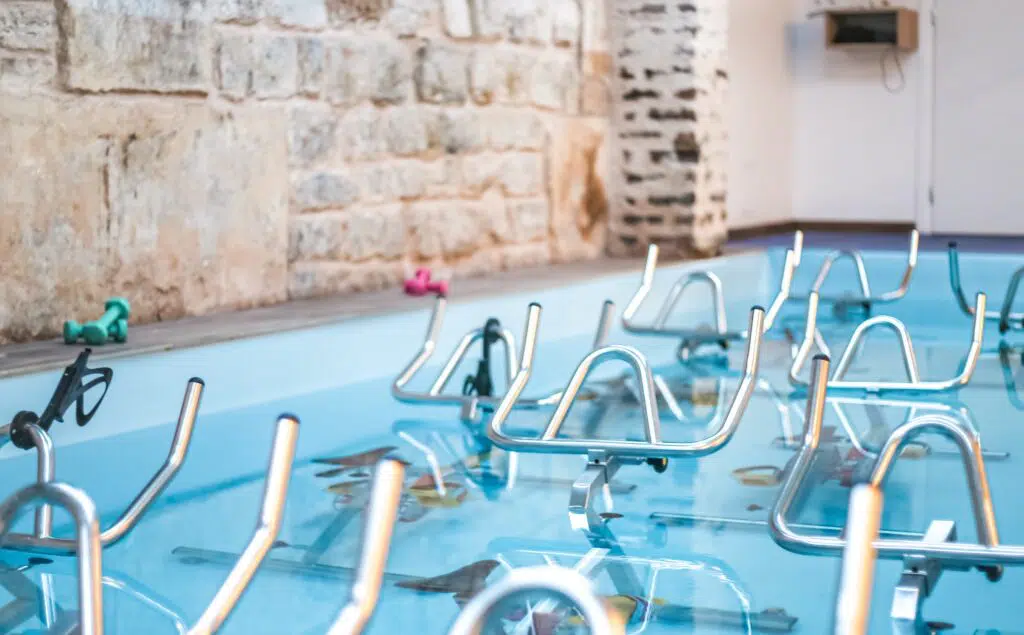
- of pedalo (Aquabike) for cardio and legs.,
- of the Water race (aqua-running or aqua-jogging) for breathing.,
- exercises reinforcement with floating dumbbells or resistance bands,
- Sometimes even aquatic trampolines for explosive work.
Each workshop lasts a few minutes. Then we change. We restart. We vary.
Result: no monotony, a dynamic rhythm and a full-body workout.
Another key point: the intensity remains adaptable.
You can push yourself to the limit... or take your foot off the pedal a bit. The water absorbs impact, supports your movements, and allows you to go further without jarring your joints.
In summary?
Aquatraining is a complete, fun and structured workout, which combines cardio and strength training, in an environment that is both buoyant and resistant. A strange paradox, and that's exactly what makes it so effective.
Aquatraining, aquafitness and aquagym: what are the differences
These three terms are similar. They are often confused. And yet, they do not mean quite the same thing.
Aquagym
This is the gentlest and most accessible version.
Simple movements, often collective, are practiced here to music. The main objective: to move, maintain fitness, and improve mobility and circulation.
Perfect for getting moving again or for a wellness activity.
Aquafitness
We're stepping up a gear.
The exercises become more toning, the pace more sustained, the accessories more present. We seek more energy expenditure and muscle strengthening.
We're already getting close to a proper fitness class... in the water.
Aquatraining
Here, we're changing the logic.
We no longer just follow a collective sequence of movements. We enter into a Training“, with workshops, transitions, intensity variations, and specific objectives for each muscle group.
It is:
- more structured,
- more varied,
- often more intense,
- and significantly more complete.
If aqua aerobics gets you moving, if aqua fitness tones, Aquatraining trains.
The benefits of aquatraining for the body
If aquatraining is so appealing, it's not by chance.
Its great asset lies in one word: balance.
Balance between effort and comfort. Between intensity and joint protection. Between pleasure and effectiveness.
In water, your body works differently. Every movement requires more energy but generates less impact. You engage your muscles deeply, stimulate your heart, and activate your circulation… all without the hardness of the ground.
In other words: you do more, while being kind to your body.
A rare combination. And a precious one.
The cardio-respiratory benefits
Aquatraining works the heart, and it does it well.
The workshops follow one another. The pace quickens. The breathing quickens.
Your heart rate climbs, then drops, then climbs again. This pattern of variation stimulates the cardiorespiratory system and improves endurance over successive sessions.
Another peculiarity: water offers constant resistance.
Even simple movements require more effort than in the open air. Result: your heart works harder... without you always feeling like you're pushing yourself.
Many practitioners say so:
“I got out of breath and I sweated, but without that crushing feeling you sometimes get in high-impact sports.”
In the medium term, you gain stamina, enhance your capacity for effort, and experience greater comfort in daily life. Climbing stairs becomes easier. Walking briskly no longer leaves you breathless. And your general energy levels improve.
Full body strength training
Aquatic training does not target an isolated muscle.
It works the whole body, at the same time.
The legs push against the water.
The arms pull, press, stabilise.
The torso engages to maintain balance.
Every movement becomes a disguised strength exercise.
Contrary to popular belief, water does not “facilitate” effort.
She makes him more intelligent.
You're fighting a gentle but permanent resistance. Your core muscles engage. Your core strength activates without you even thinking about it.
This explains why, after a few weeks, many notice:
- a straighter posture,
- a more toned stomach,
- firmer arms,
- stronger legs.
And often with no significant muscle soreness the next day.
A luxury.
Body toning and silhouette refinement
Yes, aquatraining tones.
As you repeat the movements, push the water, and maintain your balance, your muscles tone up. Your figure becomes more defined. Your shape is refined.
But beware of miracle cures.
Aquatraining doesn't “sculpt” a body in two weeks.
It acts for the long haul. It builds. It refines. It harmonises.
With regular practice, many observe:
- a more defined waist,
- Smoother thighs,
- more toned arms,
- a flatter tummy.
Why?
Because you combine cardio, strengthening, and drainage.
Three essential levers for transforming a body, without harshness.
The effects on blood circulation and heavy legs
It's one of the most appreciated benefits. And one of the most immediate.
Water exerts natural pressure on your limbs.
This pressure promotes venous return and limits blood pooling in the legs.
Add to that the continuous movement and you get a very marked draining effect.
Many female practitioners describe the same sensation after a session:
Lighter, less swollen, more “alive” legs.
For those who spend their days standing or sitting, it's a real relief.
And no, it's not just your imagination.
Aquatraining and the appearance of cellulite
Sensitive topic. Highly requested topic.
Let's be clear:
Aquatraining is not a cellulite treatment.
However, it acts on several factors that influence its appearance:
- blood circulation,
- lymphatic drainage,
- muscle tone,
- total body fat.
By improving these parameters, some people may notice smoother, firmer, and less “grainy” skin.
But here, no magic speeches.
Results vary depending on regularity, diet, hydration, and genetics.
Let's put it this way:
Aquatraining doesn't make cellulite disappear by magic.
But it creates a much more favourable landscape for its mitigation.
The benefits of aquatraining on the mind
We often talk about the body. Muscles. Cardio. Figure.
But what many discover with aquatraining, sometimes to their great surprise, is its impact on the mind.
Yes, on the mental side.
Because at its core, moving in water isn't just about sweating.
It soothes. It frees. It resets everything.
And for many female practitioners, it's even the first benefit they feel.
Reducing stress and anxiety
As soon as you enter the water, something changes.
The noise is fading.
The sensations become softer.
The body relaxes, almost unwillingly.
Water envelops. It carries. It slows down certain movements.
She's creating a cocoon shape.
Add to that physical exertion, and you have a formidable cocktail for combating stress.
During an aqua-training session, you don't really have a choice:
You must concentrate on your movements, your breathing, your balance.
Impossible to mull over your day.
Impossible to revisit this morning's meeting in your head.
Your mind refocuses on the present moment.
Result:
Mental tensions fall.
The pressure is dropping again.
The nervous system calms down.
Many come away with this simple phrase:
“I feel lighter. In my head too.”
Improving mood and motivation
Aqua training does wonders for your morale. Really.
Firstly because physical exercise releases endorphins, those famous hormones of well-being.
Next, because the water, the music, and the collective rhythm create a positive, almost euphoric atmosphere.
We smile more.
One feels proud of oneself.
We say to ourselves: “Okay, I've done it.”
And that changes everything.
Unlike some sports experienced as a chore, aquatraining fosters a gentler relationship with exertion.
It's happening, yes.
We work hard, sometimes.
But we leave with a pleasant, not overwhelming, feeling.
That's what explains why so many people last the distance.
Not because you have to “force yourself”.
But because we want to go back.
And motivation, in sports practice, is gold.
The effects on sleep and recovery
Another often underestimated benefit: sleep.
After an aqua-training session, the body feels healthily tired.
The muscles have worked.
The heart has been stimulated.
Stress has decreased.
In the evening, falling asleep becomes easier.
Deeper sleep.
Less frequent night awakenings.
Many female practitioners notice that they sleep better on days they have a session.
You don't need to be a scientist to understand why.
When the body moves,
when the mind relaxes,
when tensions drop,
Sleep follows.
And sleeping better means recovering faster, managing your emotions better, and coping better with the mental load of everyday life.
A virtuous circle, quite simply.
Frequently Asked Questions about Aquatraining
When you discover aquatraining, a flurry of questions often arrives at the same time.
It's normal. You're entering a slightly new world, combining sport, water, and fitness.
So let's keep it simple.
Here are the answers to our most frequently asked questions.
Do you need to know how to swim to do aquatraining?
Good news: no, not necessarily.
The majority of aquatraining sessions take place in pools where you can stand.
You stand still. You walk. You run in the water. You cycle on a stationary exercise bike in the water.
In short, you are not floating in the middle of the pool.
The coaches also adapt the exercises to the depth of the water and the level of the group.
You always keep a foothold.
And if you have any doubts, you can express your concerns at the beginning of the session.
If you can swim, all the better.
If not, you can still practice with peace of mind.
Does aquatraining really help you lose weight?
The question keeps coming up.
And the answer deserves a bit of nuance.
Yes, aquatraining can contribute to weight loss.
But no, it's not a magic wand.
Why does that work?
- You burn calories through cardio.
- You are building muscle, which increases your resting energy expenditure.
- You move more, without hating the effort.
But the results depend on three things:
- Your regularity,
- the intensity of your sessions,
- your overall lifestyle.
If you exercise two to three times a week and eat a balanced diet, you'll create a really favourable environment for losing body fat.
Let's be frank:
Aqua training doesn't make you lose weight on its own.
But it helps a lot. And more importantly, it helps for a long time.
Is this suitable for back pain or knee pain
In many cases, yes.
One of the great advantages of aquatraining is the low joint stress.
The water carries some of your weight.
The impacts disappear almost completely.
Result:
- less pressure on the knees,
- fewer shocks in the vertebral column,
- more freedom of movement.
Many people suffering from chronic pain find aquatraining to be a finally bearable activity.
But be careful.
If you have a serious condition, a slipped disc, advanced osteoarthritis or acute pain, it is best to seek medical advice before starting.
Aquatraining often provides relief.
It does not replace medical follow-up.
Can aquatraining be practiced all year round
Yes. And it’s even one of its major strengths.
Unlike some seasonal sports, aquatraining is practiced in an indoor swimming pool, in heated water.
Rain, cold, heatwave… it doesn't matter.
In winter, it's a warm and motivating cocoon.
In summer, it's refreshing and invigorating.
In other words:
No excuse for the weather.
No forced break.
You can build real consistency over twelve months.
And this is where the benefits take hold permanently.
Contraindications and precautions
Aquatraining is a gentle, water-supported activity, accessible to a very wide audience.
It's even one of its great strengths.
Softer doesn't mean harmless.
Like any sport, it requires a minimum of common sense, listening to your body… and sometimes medical advice.
It is better to ask the right questions before your body forces them upon you.
Cases where medical advice is recommended
In most situations, you can start aquatraining without any special formalities.
However, some people would benefit from asking their doctor's advice before embarking on something.
This is particularly the case if you:
- suffer from a known heart or respiratory condition,
- have balance problems,
- just out of a recent operation,
- are in functional rehabilitation,
- presents with significant chronic pain,
- You are pregnant.
Why this caution?
Because aqua training remains a physical effort.
Your heart is working.
Your breathing quickens.
Your muscles are contracting.
Even in water, the body does real work.
A medical certificate simply validates that the activity is suitable for you, allows for intensity adjustments if needed, and enables you to participate with peace of mind.
And frankly... a reassuring validation is better than persistent doubt.
Situations where aquatraining is not recommended
There are also a few situations where it is better to postpone a session, or even avoid the practice.
This is the case if you have:
- an ongoing infection (fever, flu, ear, nose, or throat infection),
- an open wound or contagious skin condition,
- an acute inflammation of a joint,
- a sharp and recent pain with no clear diagnosis.
In these cases, the message is simple:
Rest first, sport second.
Forcing yourself “to not lose rhythm” is rarely a good idea.
Your body remembers everything. And it will remind you.
Another often-forgotten point:
If you are very tired, very stressed, or sleep-deprived, adjust the intensity or postpone the session.
Aqua training is good for you.
But it must never become an additional constraint.